Do Now: Quickly look over the four sources below. Since 1776, how did the United States deal with the divisive issue of slavery? Use at least two of the sources.
Source 1: Thomas Jefferson's notes on the debate in the Continental Congress, July 2, 1776
Congress proceeded the same day to consider the Declaration of Independence which had been reported & laid on the table the Friday preceding and on Monday referred to a committee of the whole. The pusillanimous idea that we had friends in England worth keeping terms with, still haunted the minds of many. For this reason those passages which conveyed censures on the people of England were struck out, lest they should give them offence. The clause too, reprobating the enslaving the inhabitants of Africa, was struck out in complaisance to South Carolina & Georgia, who had never attempted to restrain the importation of slaves, and who on the contrary still wished to continue it. Our Northern brethren also I believe felt a little tender under those censures; for tho' their people have very few slaves themselves yet they had been pretty considerable carriers of them to others.
Source 2: The Northwest Ordinance (1787) stated that the western territories could become states equal to the original states (rather than remaining colonies) and banned slavery in the region north of the Ohio River. When a territory's population reached 60,000, it could write a state constitution and apply to Congress for statehood.
Source 3: U.S. Constitution, Article I, Section 2, Clause 3 (the Three-Fifths Compromise, 1787)
Representatives and direct Taxes shall be apportioned among the several States which may be included within this Union, according to their respective Numbers, which shall be determined by adding to the whole Number of free Persons, including those bound to Service for a Term of Years, and excluding Indians not taxed, three fifths of all other Persons.
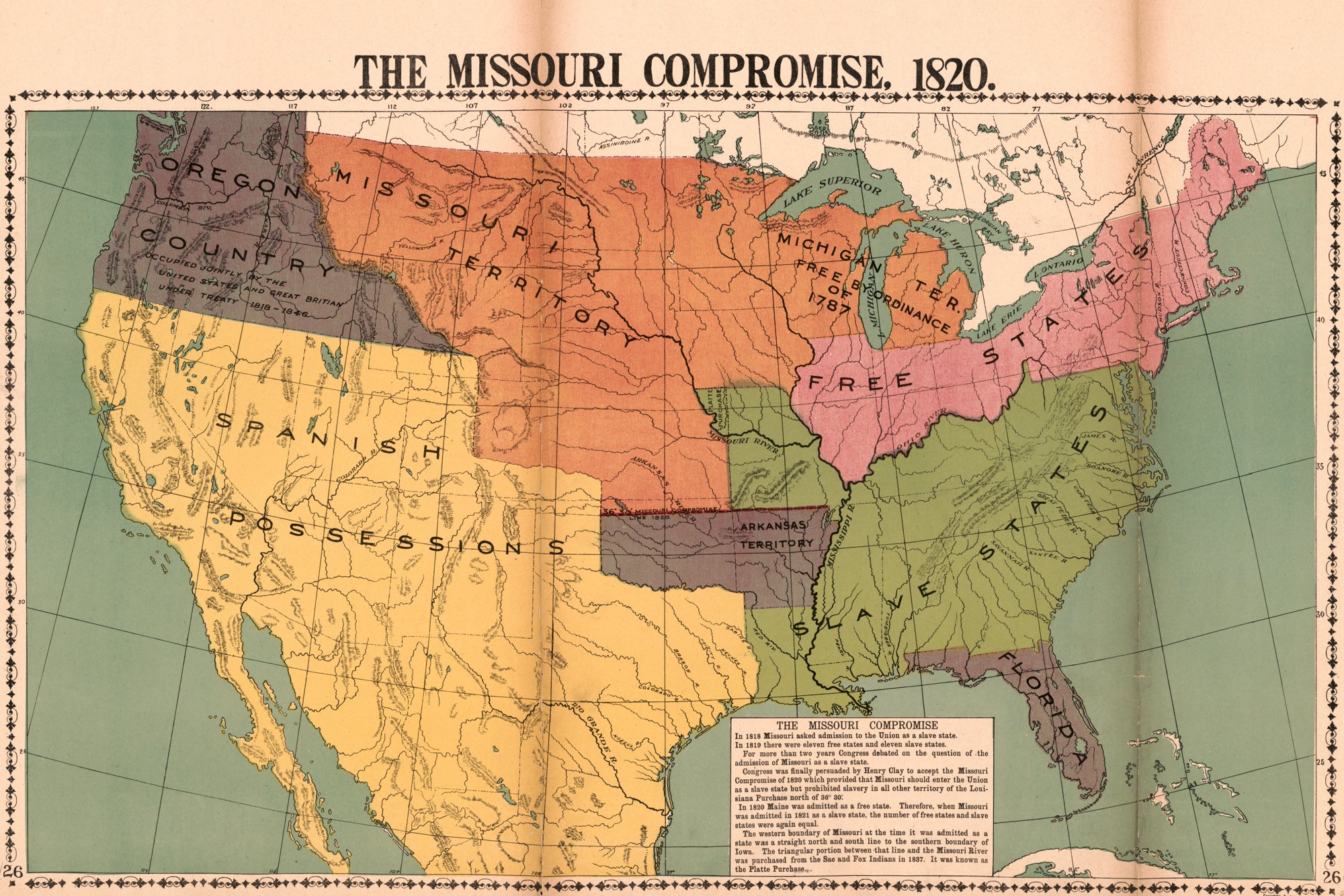 Source 4 map: Map: The Missouri Compromise, 1820. Library of Congress, Geography and Map Division
Source 4: The Missouri Compromise (1820) admitted Missouri as a slave state and Maine as a free state, keeping the balance of slave and free states in the Senate. It banned slavery in the rest of the Louisiana Purchase north of the 36°30' line. The deal was almost derailed when Missouri's proslavery constitutional convention added a clause barring free Black people from entering the state, which critics said violated the U.S. Constitution.